BACKGROUNDThe ISS is the single largest international aerospace project ever undertaken by humankind. It draws upon the resources and scientific expertise of 16 cooperating nations, including the United States, Canada, Japan, Russia and 11 participating member nations of the European Space Agency - Belgium, Denmark, France, Germany, Italy, The Netherlands, Norway, Spain, Sweden, Switzerland and the United Kingdom. In addition, Brazil and Italy have signed on as payload participants. The contribution of each country to the ISS is shown in the color-coded diagram below.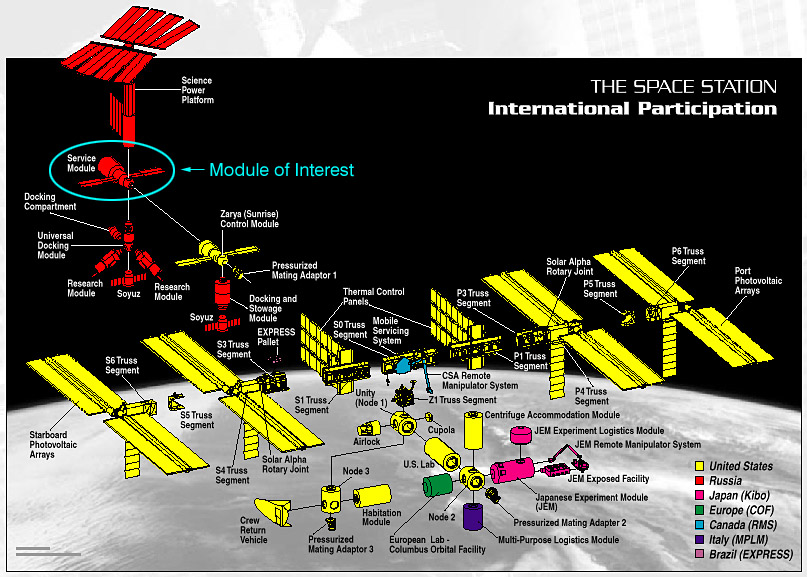
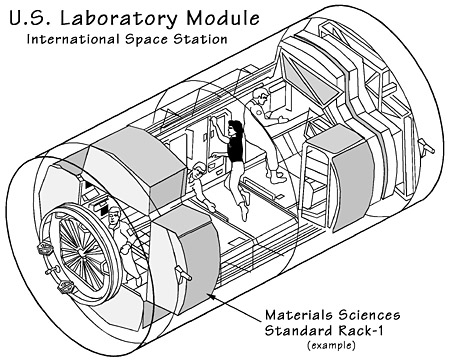
Construction in orbit began in November 1998 and a total of 44 launches will be required to complete the facility in 2004. The total estimated cost for building the ISS is between $35 and $37 billion. When the ISS is completed, it will have a wingspan of 356 feet, 290 feet long and will be 143 feet tall. Its mass will be nearly one million pounds and it will provide living space for up to seven astronauts and scientists. The pressurized living and working space aboard the completed station will be more than 46,000 cubic feet, roughly equivalent to the passenger cabin volume of two 747 jetliners. The mission of the ISS is to enable the long-term exploration of space and provide benefits to people on Earth. Several of these benefits will be the result of research conducted in the U.S. laboratory (see diagram), i) Cures for diseases such as influenza, diabetes, cancer, osteoporosis, and AIDS.A crucial component of the ISS is the Zvezda Service Module 1R, the living quarters for humans on the ISS, and our next topic of discussion. A Physical Description of the Service Module: 42,000 poundsScheduled to launch between December 26, 1999 and January 16, 2000 via a Russian Proton Rocket, the Zvezda Service Module will house the first 7 scientists and astronauts to board the ISS space station. It will provide the living quarters, life support system, electrical power distribution, data processing system, and flight control system for the early stages of the ISS. In addition to serving as the preliminary living quarters, it will provide "propulsive attitude control and reboost capability"1 for the space station. It also will provide a communications system that includes remote command capabilities from ground flight controllers.
1. http://spaceflight.nasa.gov/station/assembly/elements/sm/eanalog.html |