|
The Results
of applying different spectral and time-frequency analyses seemed to simply verify the standard knowledge about both the properties of the various analyses and the properties of the heart rate. In general, we learned that analysis of the heart rate variability data does show semi-consistent evidence of two frequency peaks at frequencies corresponding to those in current medical publications. Furthermore, we observed frequency damping of one of the peaks in mice whose corresponding neural system had been chemically suppressed. As seen with EMD analysis, these two neural systems cannot be characterized by a single frequency or a single frequency spectrum, as they are nonstationary signals, but the frequency band bounds for each neural system can be defined and assumed to be correct for the vast majority of the time.
Additionally, we saw that certain spectral and time-frequency analyses are preferential to others, especially when it is known that the signal is either nonstationary or nonlinear. Since the physiology of these systems shows that they are both nonstationary and nonlinear, we knew before we started this project that some analyses sould perform better than others, and in our project we have effectively confirmed that this is the case. The general spectrogram, while giving insight into the general frequency distribution of our signal, was unable to generate consistent frequency peaks except at the most general level, and we could only confirm from this analysis that our data is predominantly a low-frequency signal. The Short Time Fourier Transform, while able to show nonstationary trends, had a terrible frequency resolution which prevented us from extracting any meaningful trends from the data, except that again, our data is primarily a low-frequency signal. The Smoothed-Pseudo Wigner-Ville analysis, while showing some time and frequency trends, also had a poor frequency resolution, and we confirmed nothing more that what was shown with the previous two analyses. With EMD, on the other hand, we were able to obtain excellent frequency and time resolution, and EMD also showed fairly consistently the two peaks associated with the two neural systems. This result is in line with the ability of EMD to perform nonstationary and nonlinear analyses. Therefore we highly recommend EMD as a tool for analyzing heart rate variability data, and in particular for monitoring the two neural systems that are of medical significance.
The variability studies seemed quite successful. Mutiple tests were performed on a single mouse, before injections, and afterinjections of propanol and aldarol. These drugs block the sympathetic and parasympathetic nervous systems.
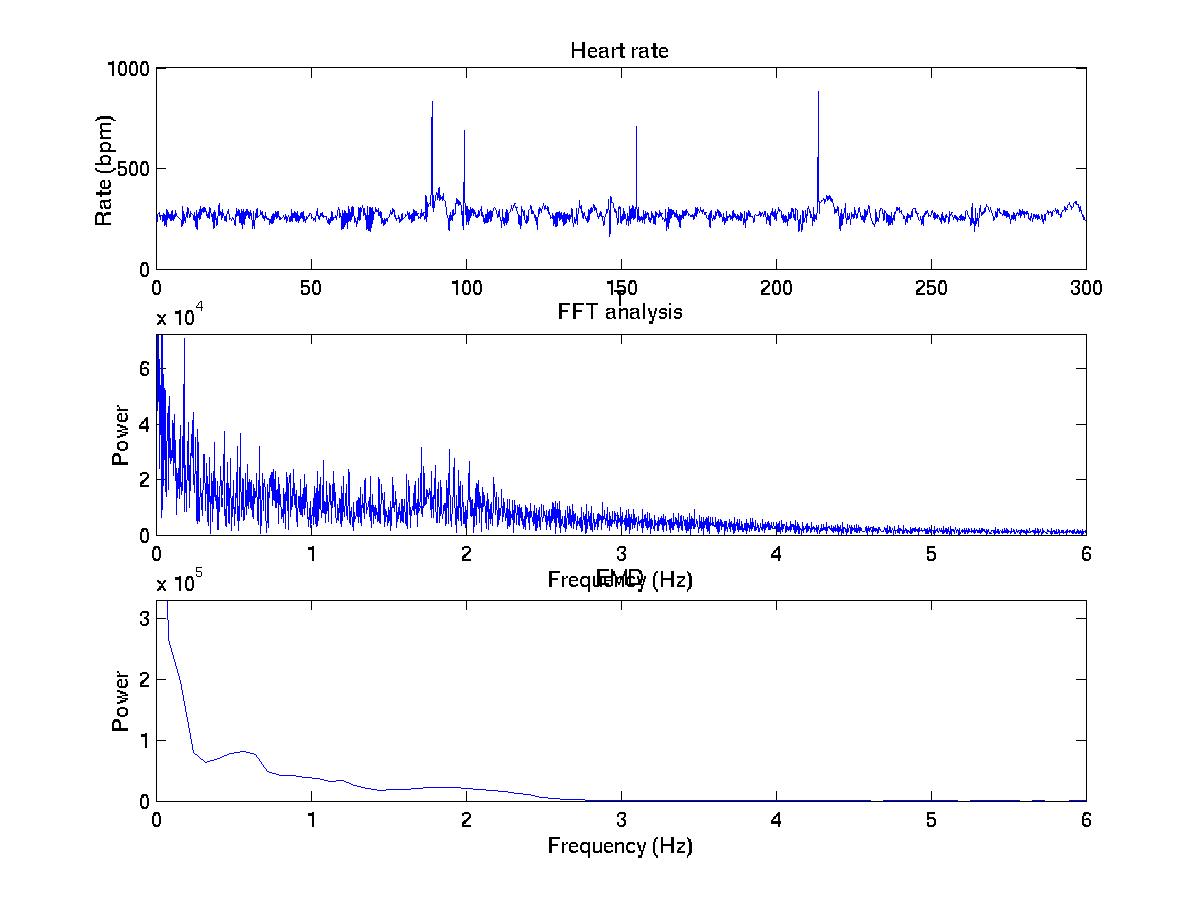
Before injection #1
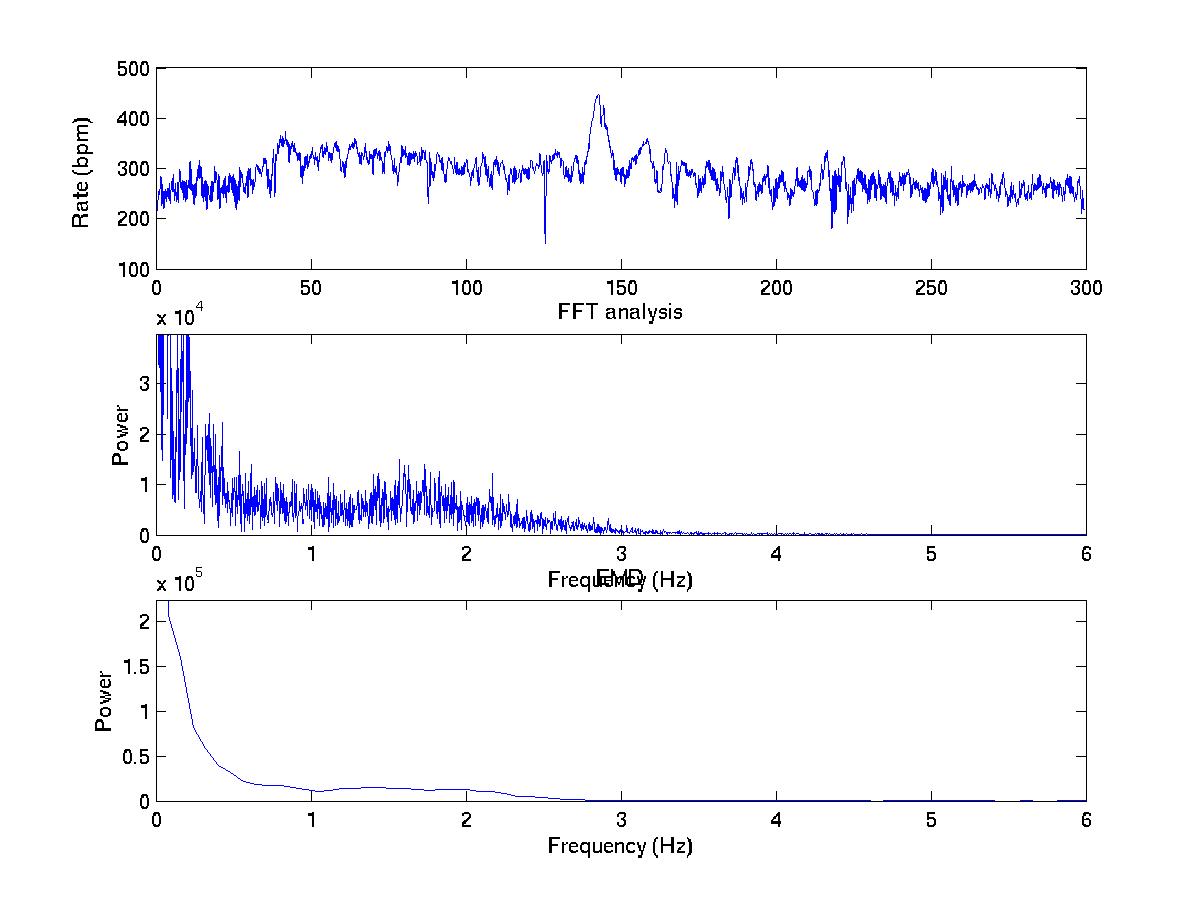
Before injection #2
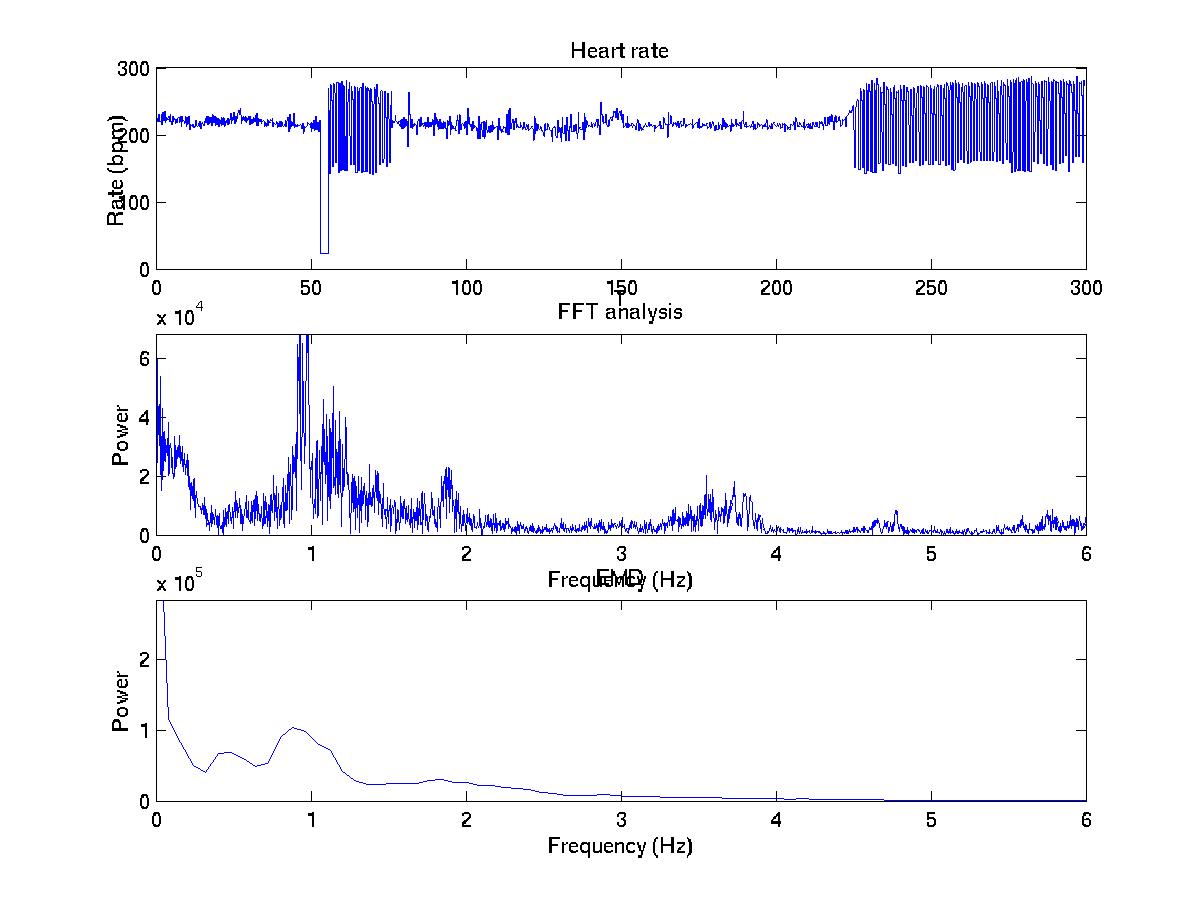
After injection 1 #1
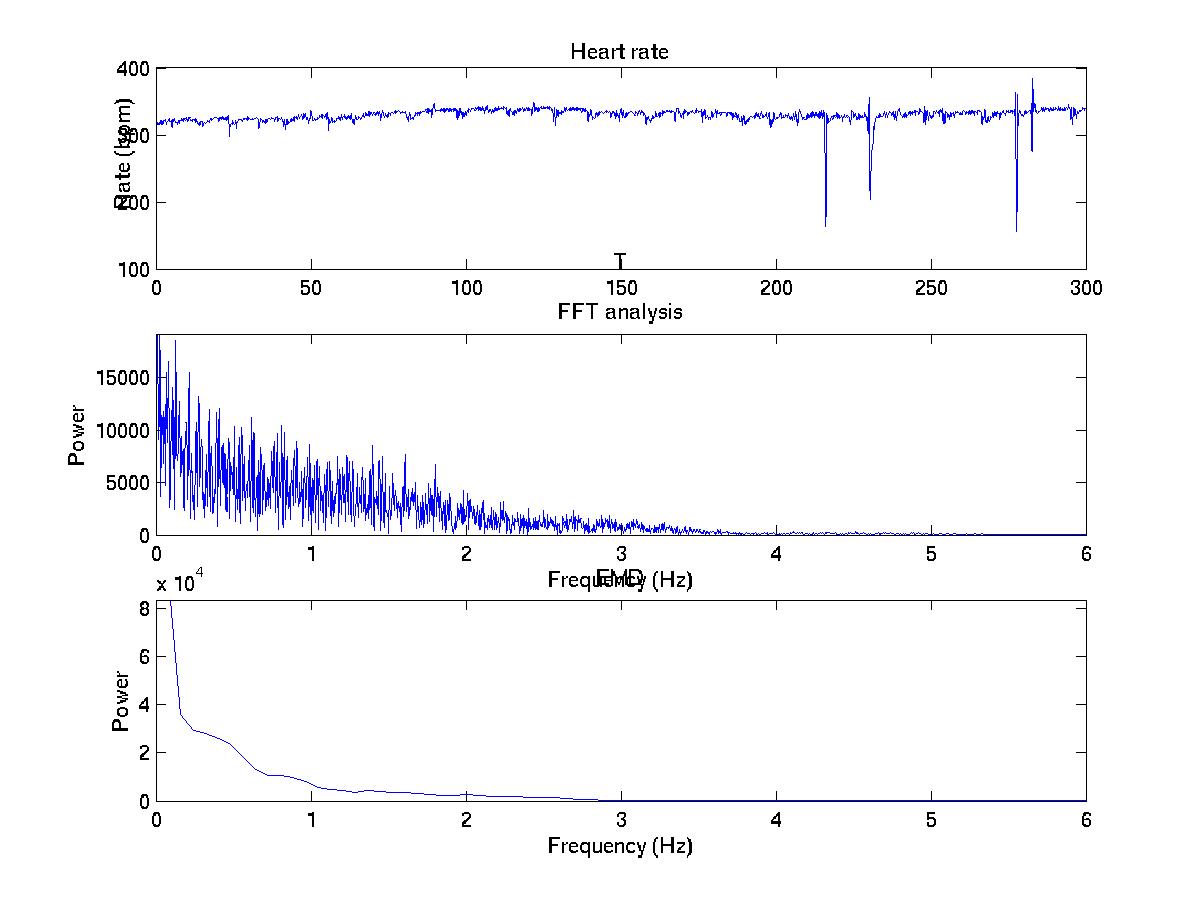
After injection 1 #2
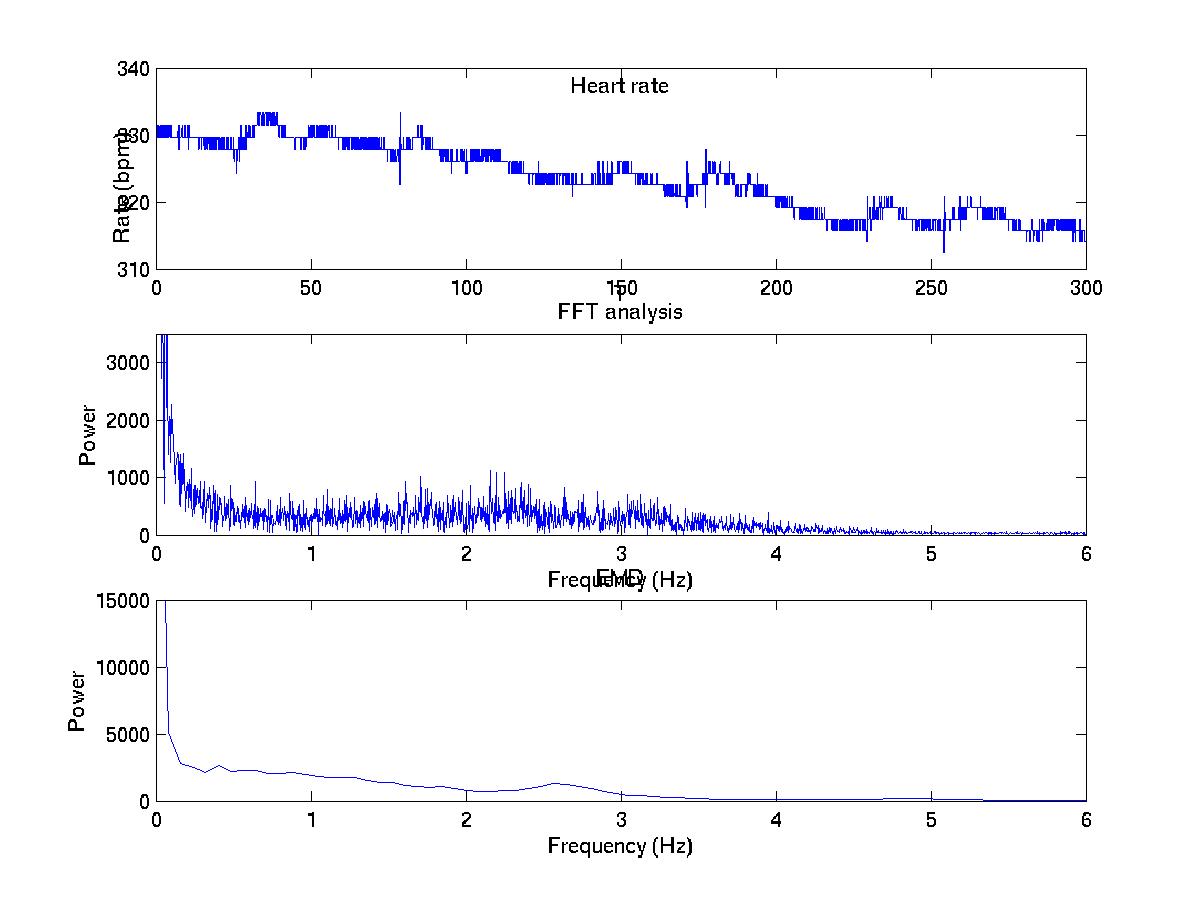
After injection 2 #1
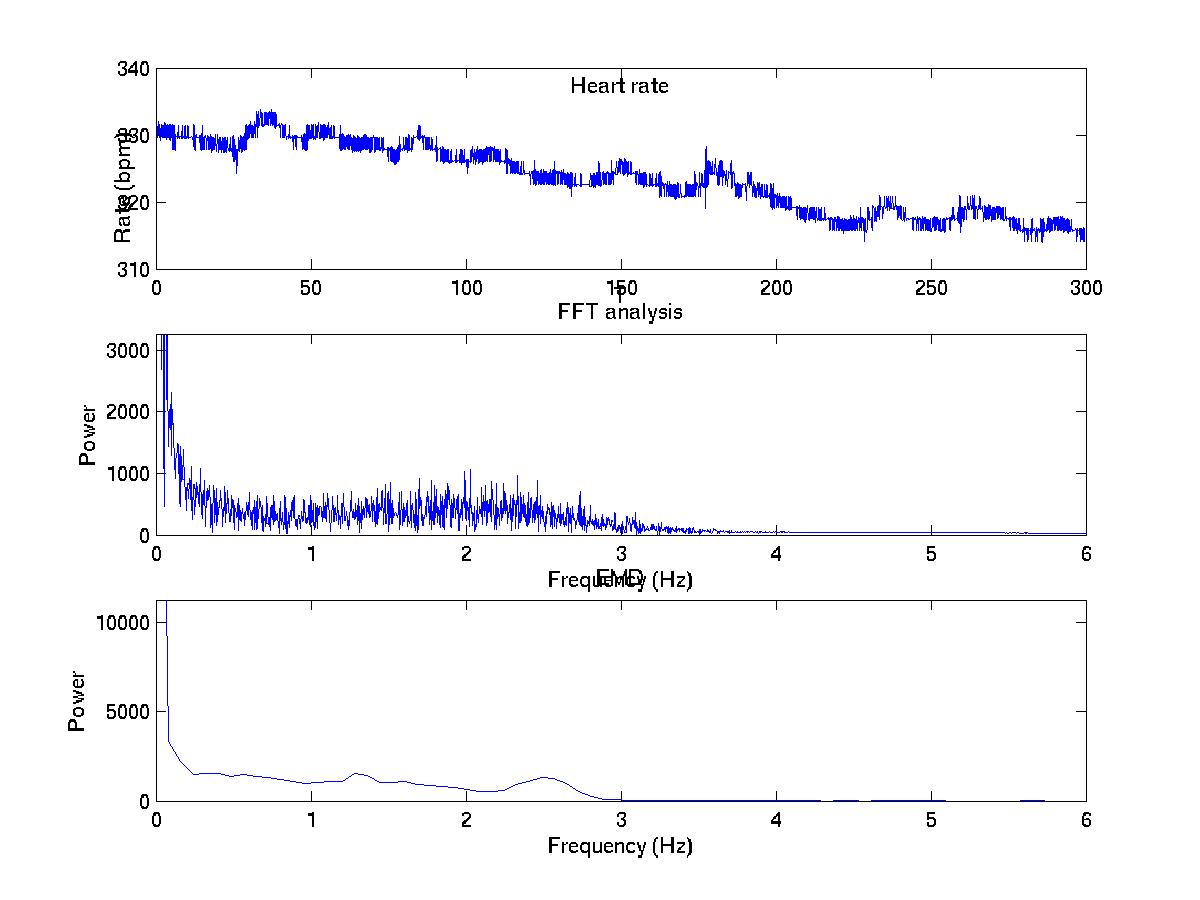
After injection 2 #2
After injection 1, it is not clear what happens, because the spectrum is not consistent enough initially. However, the lower frequency peak does seem to be accentuated. The other problem is it is hard to tell if the heart rate detection worked well enough, or if it is causing the blurring oberved in the spectrum.
After injection 2, it is clear that the total spectral variability has greatly decreased. However, the high frequency content is still present.
However, these results are not enough to go one way or the other. There does not seem to be enough consistency to attributable real physiological changes to any of the spectral peaks. This iconsistency could also be explained by the nature of the transgenic mice, which have not been that well characterized either. Verification of the algorithm against natural mice would be necessary before trying to attempt this. On the other hand, it is observable that the peaks become less after injections, and for the second frequency the high frequencies seem more apparent.
|
